
Cyborg rituals.
2024 • immersive installation
Cyborg rituals invites viewers to witness a ceremony orchestrated by an AI and performed simultaneously over a video call by two artists: Lola Rossi and Kris Hastings. The ritual seeks to invoke a digital entity. It was developed using an algorithm fed with material on cultural rituals from Norse mythology and nineteenth-century French occultism.
New forms of ritual are becoming part of contemporary life: guided meditation, virtual ceremonies, online spiritual retreats, digital funerals… These rituals provide spaces for communal expression and for inclusive, activist and fluid communities. Cyborg Rituals presents two artists performing under the direction of an artificial intelligence. Their bodies become avatars, inputs and interfaces, questioning the control we exercise or relinquish. Do we experience a real sense of spiritual elevation, or an artificial imitation produced by algorithms?
During the performance, projections appear on several levels above the audience, like intrusive pop-ups recalling the aesthetics of net.art. They intensify as a “higher digital entity” is invoked. The two artists, who have never met in person, create a shared space for communication and for exploring tensions between emotions, intuitions and non-human elements. AI becomes a mediator, a guide and a tool for reworking older practices into fluid, fragmented and multiple approaches to our postmodern cyborg identities.
The project was produced as part of the 2024 City2City programme, with support from the Centre des arts d’Enghien-les-Bains, a nationally recognised venue for art and creation, and the UNESCO Creative Cities Network.
In collaboration with Kris Hastings
Exhibition design: Vera Granger

Cyborg Rituals — installation view, Bains Numériques #11, 2024.

Cyborg Rituals — installation view, Bains Numériques #11, 2024.

Cyborg Rituals — installation view, Bains Numériques #11, 2024.

Cyborg Rituals — installation view, Bains Numériques #11, 2024.

Cyborg Rituals — installation view, Bains Numériques #11, 2024.
Soft Index
2026 • affichage en espace public et page web interactive
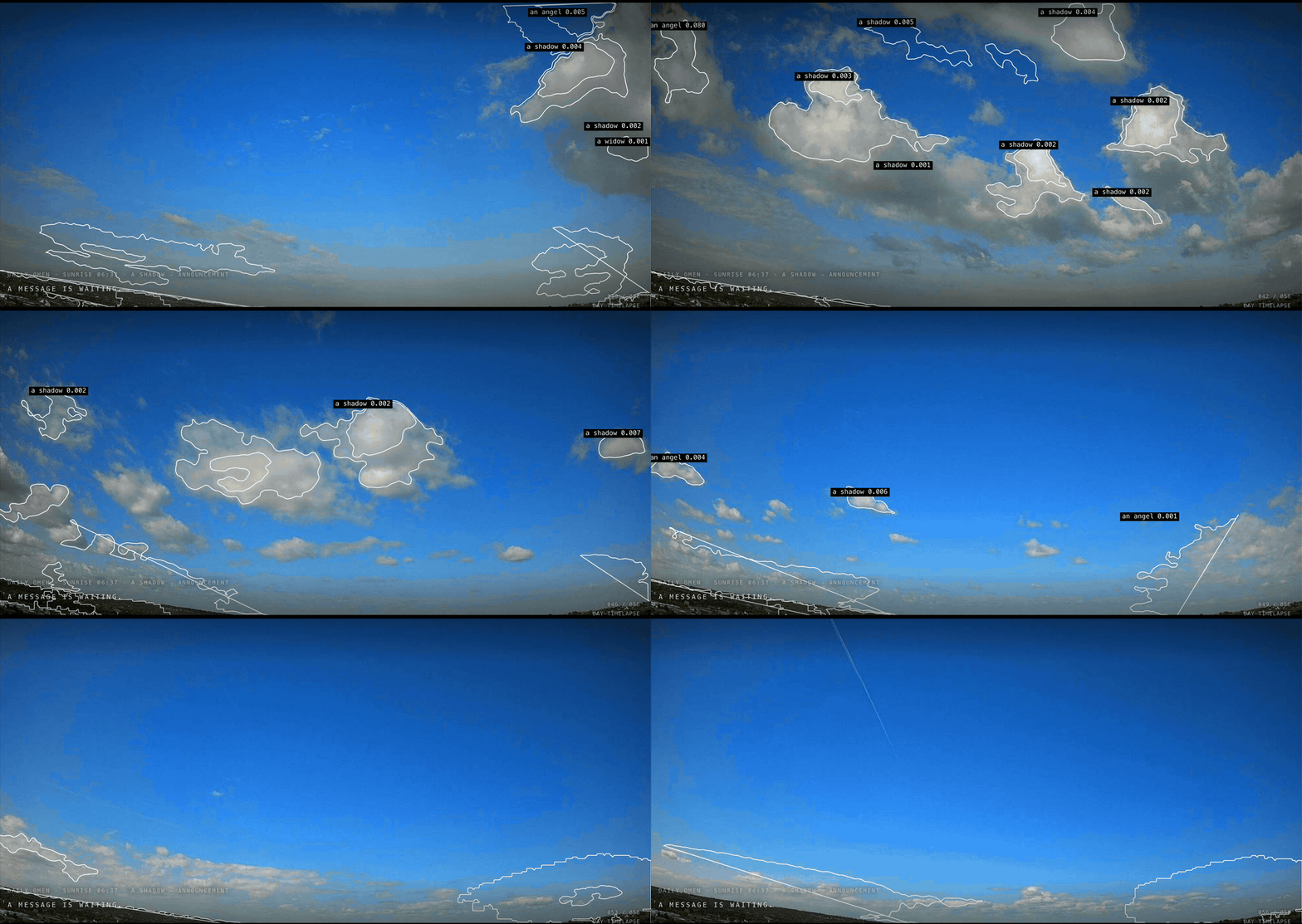
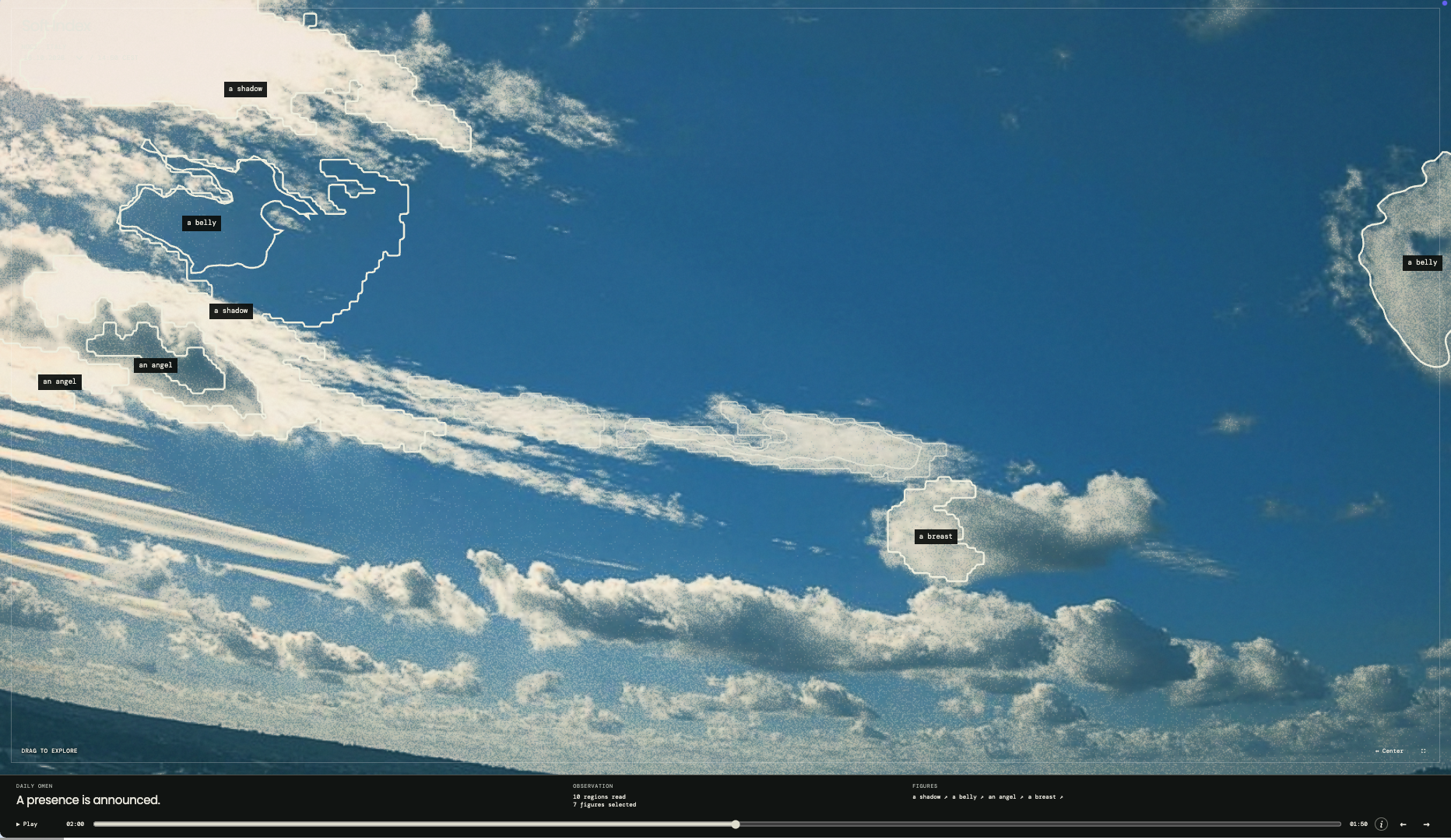
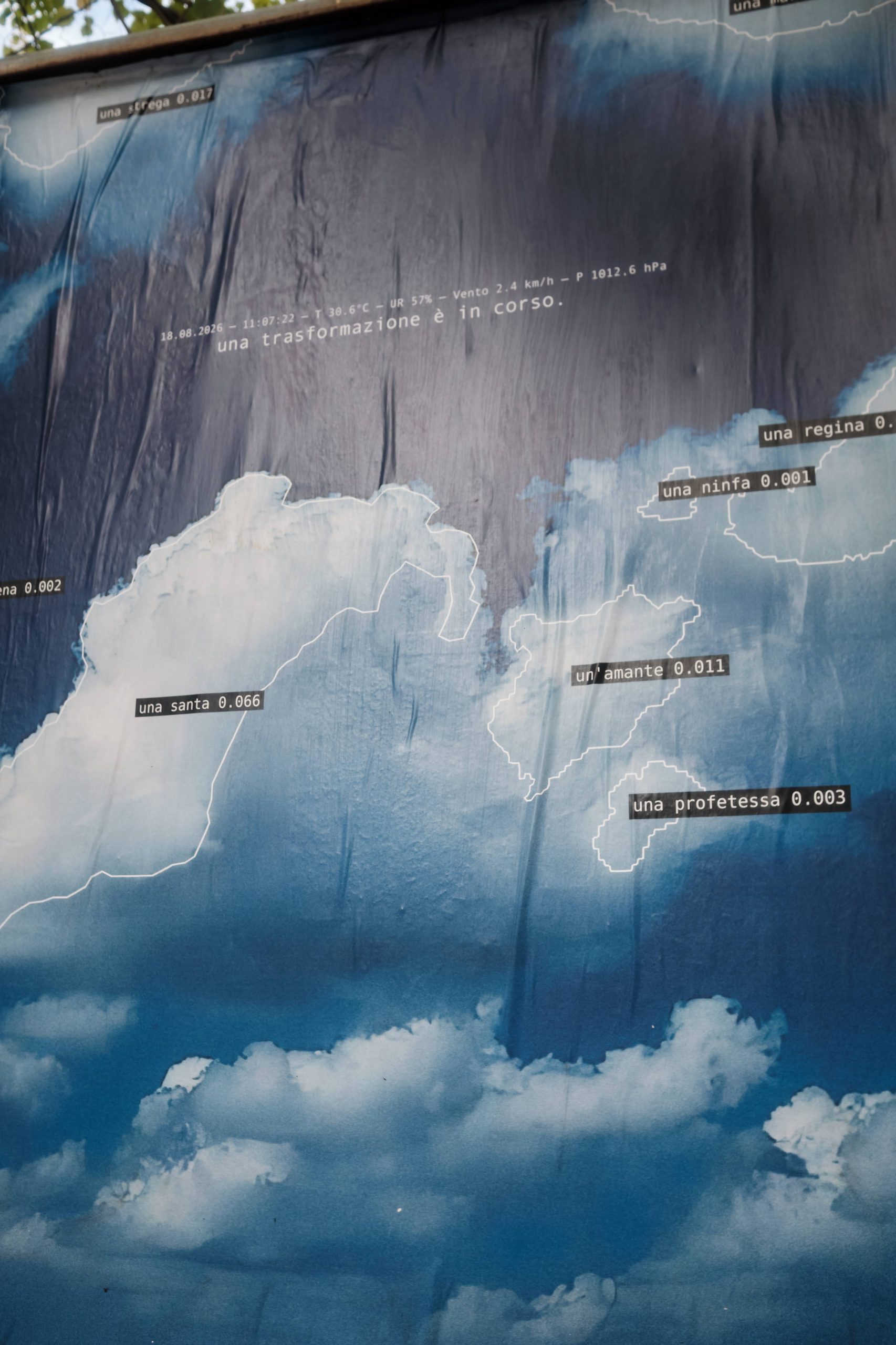
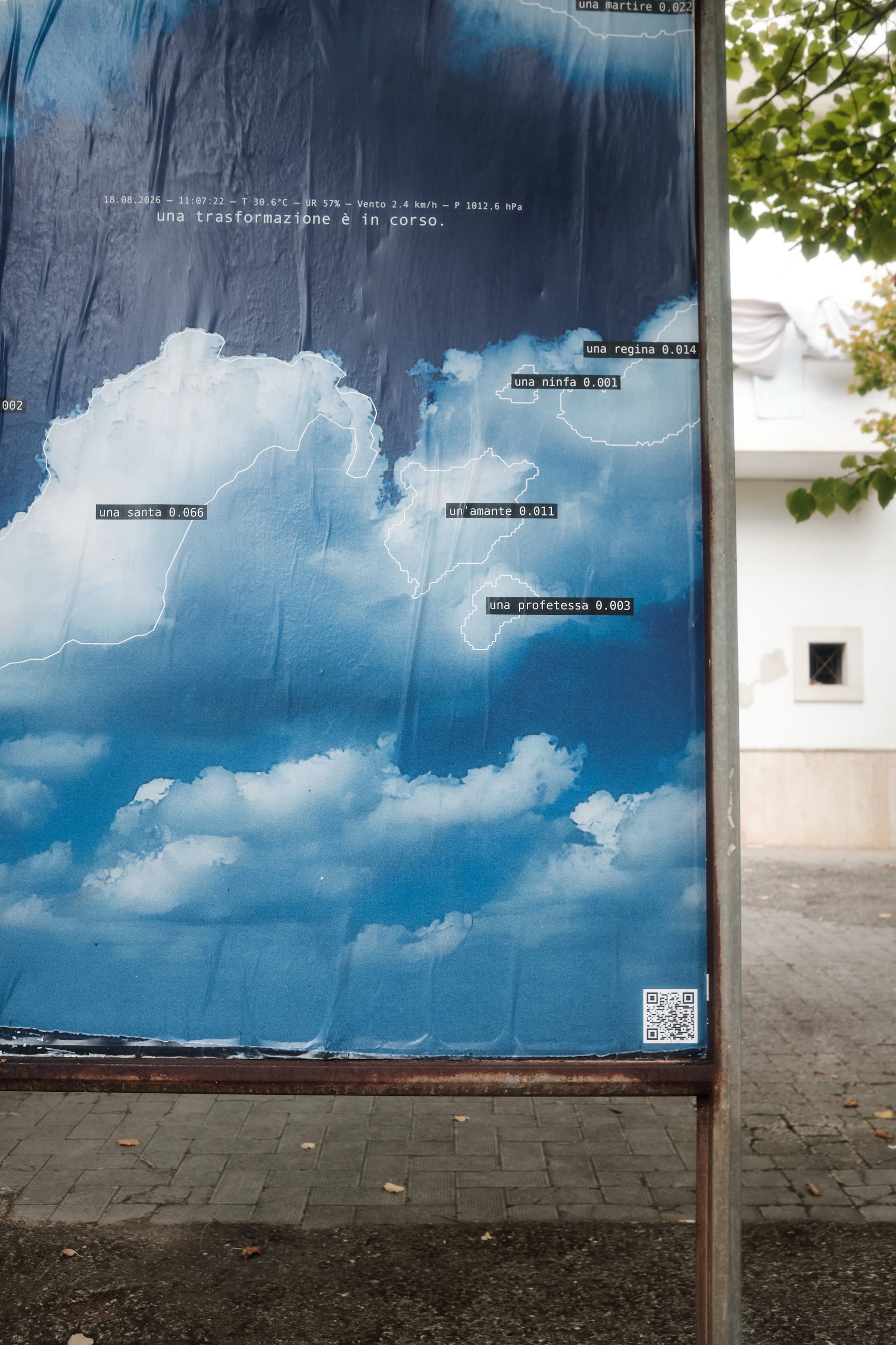
Soft Index is a research project that continuously observes the sky. Through a weather webcam, a computer vision system attempts to recognise figures in the clouds and, from these observations, formulates omens. The project unfolds online and has also been presented in public space in Noci, Puglia, Italy.
As children, we looked at the sky to find shapes in the clouds. Today, this same sky is a space increasingly under surveillance and being colonised. In some parts of the world, people look up with anxiety, waiting for a missile or a drone to appear. Elsewhere, only fragments of it are visible between buildings. And even when it seems empty, the sky is crossed, monitored and divided into zones with restricted access.
I became interested in this tension between the sky as a space for dreaming and contemplation, and the sky as a space of surveillance and control. I wanted to explore what would happen if technologies used to monitor and classify the world were redirected towards a form of contemplation. What might they recognise in shapes that constantly change and dissolve?
It was through discovering La Veille du ciel. Aquarelles météorologiques d’André des Gachons that I began to draw a parallel between meteorological observation and the ancient practice of Roman augurs. Augurs marked out a portion of the sky and observed, among other signs, the flight of birds, interpreting their movements as expressions of the gods’ will. These signs could indicate whether a proposed action had their approval.
In Soft Index, ce champ d’observation est celui d’une webcam météorologique tournée vers le ciel de Noci. Jour et nuit, le système analyse les images et tente de reconnaître des figures dans les nuages.
This search echoes the phenomenon of pareidolia, our tendency to recognise familiar figures in clouds, waves or reflections. What we see in these shapes is influenced by our memories, expectations and visual culture. But what does a machine “see” when it looks at those same clouds?
In Soft Indexit thinks it recognises a mother, a widow, a witch. A mouth, a breast, a hand. It draws boxes around areas of the image, assigning each a name and a confidence score. Fleeting shapes become figures that are named, located and accompanied by a number that gives this reading the appearance of a measurement.
From these observations, it begins to formulate omens. It becomes a kind of contemporary augur, trying to read signs of the future through images inherited from the past.
urformen_
archaeology of the future • work in progress • still images • in partnership with Carlos Barrantes (master craftsperson)
Urformen_ is a fictional archive of generated organisms that could never have existed biologically. A generative model is trained on real specimens of plants and other organisms collected in a particular area. It draws out their growth patterns, morphologies and branching structures to produce forms that resemble living things without their biological substance. Impossible organisms, informed by real biodiversity.
To give these forms a physical presence, I reclaim a nineteenth-century craft that Carlos Barrantes, a specialist in historical photographic processes, has developed into a hybrid technique: platinochromy. This process combines a platinum-palladium print—providing tonal structure, depth and 500-year permanence—with a digital colour pigment print.
The project explores form detached from function. In nature, every organic structure responds to specific physical constraints: a tree grows according to the flow of sap, coral to hydrodynamics, a shell to the mathematics of spiral growth. AI reproduces their appearance without their underlying logic. Biomechanical form, without its function.
The resulting hybrid organisms resist classification: neither plants, nor corals, nor minerals. Their structures appear organic yet defy the laws of growth, biomechanics and evolution. Their scale is ambiguous: we cannot tell whether we are looking through a microscope or standing before a monument.

Urformen_ — research image.
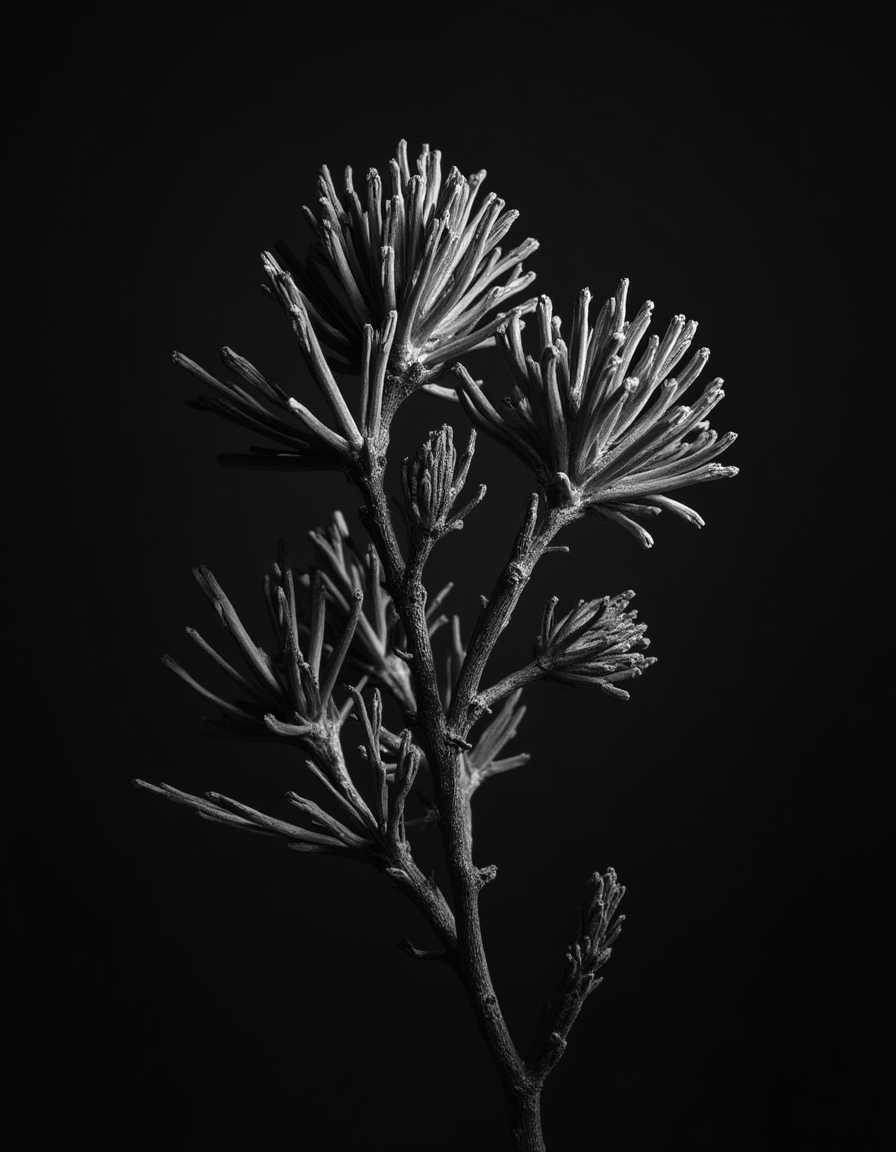
Urformen_ — research image.

Urformen_ — platinum-palladium print on Arches paper, 22 × 33 cm.
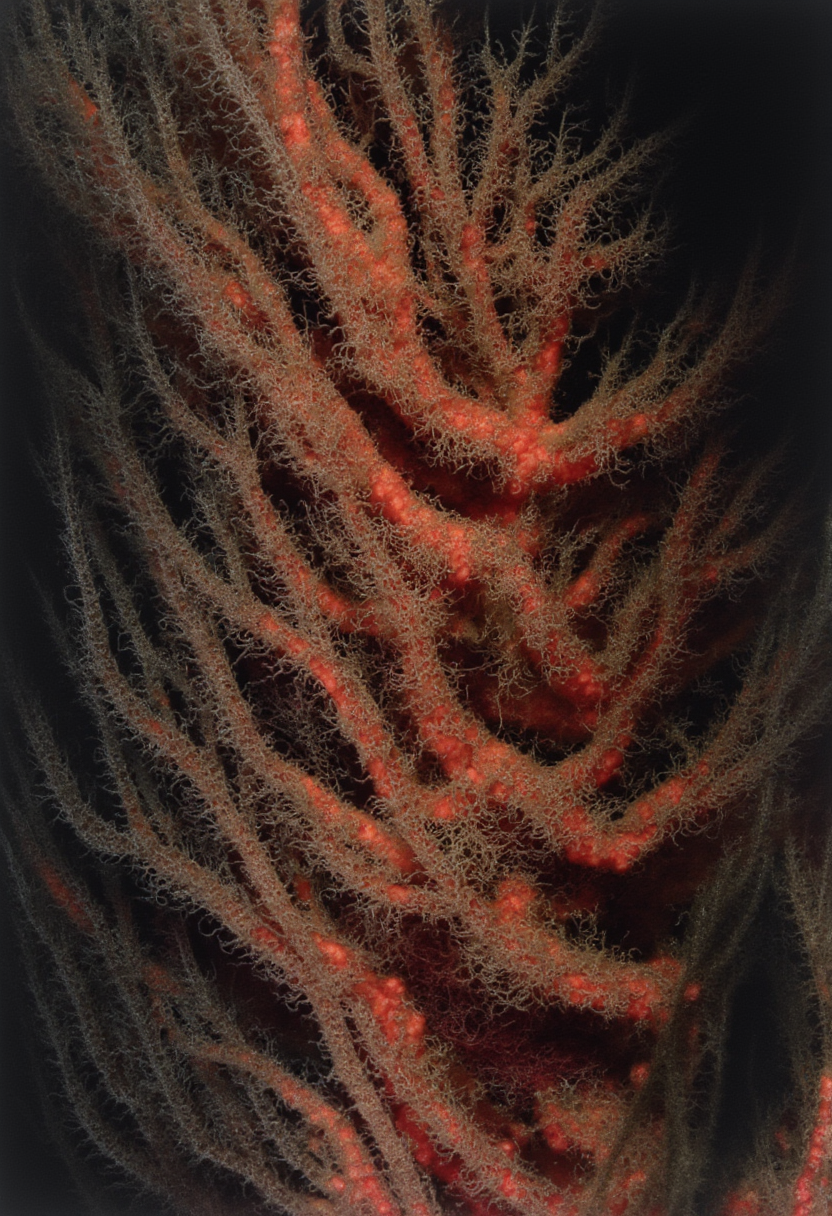
Urformen_ — research image.
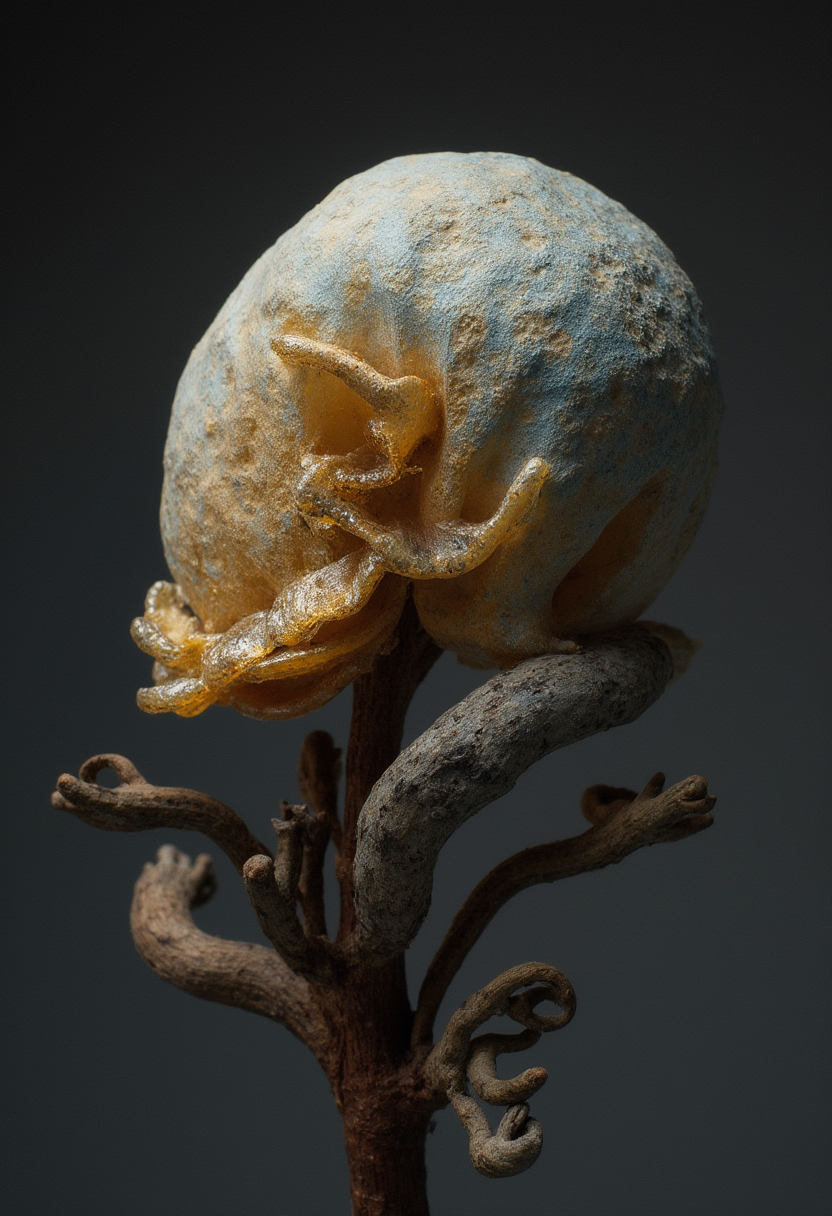
Urformen_ — research image.
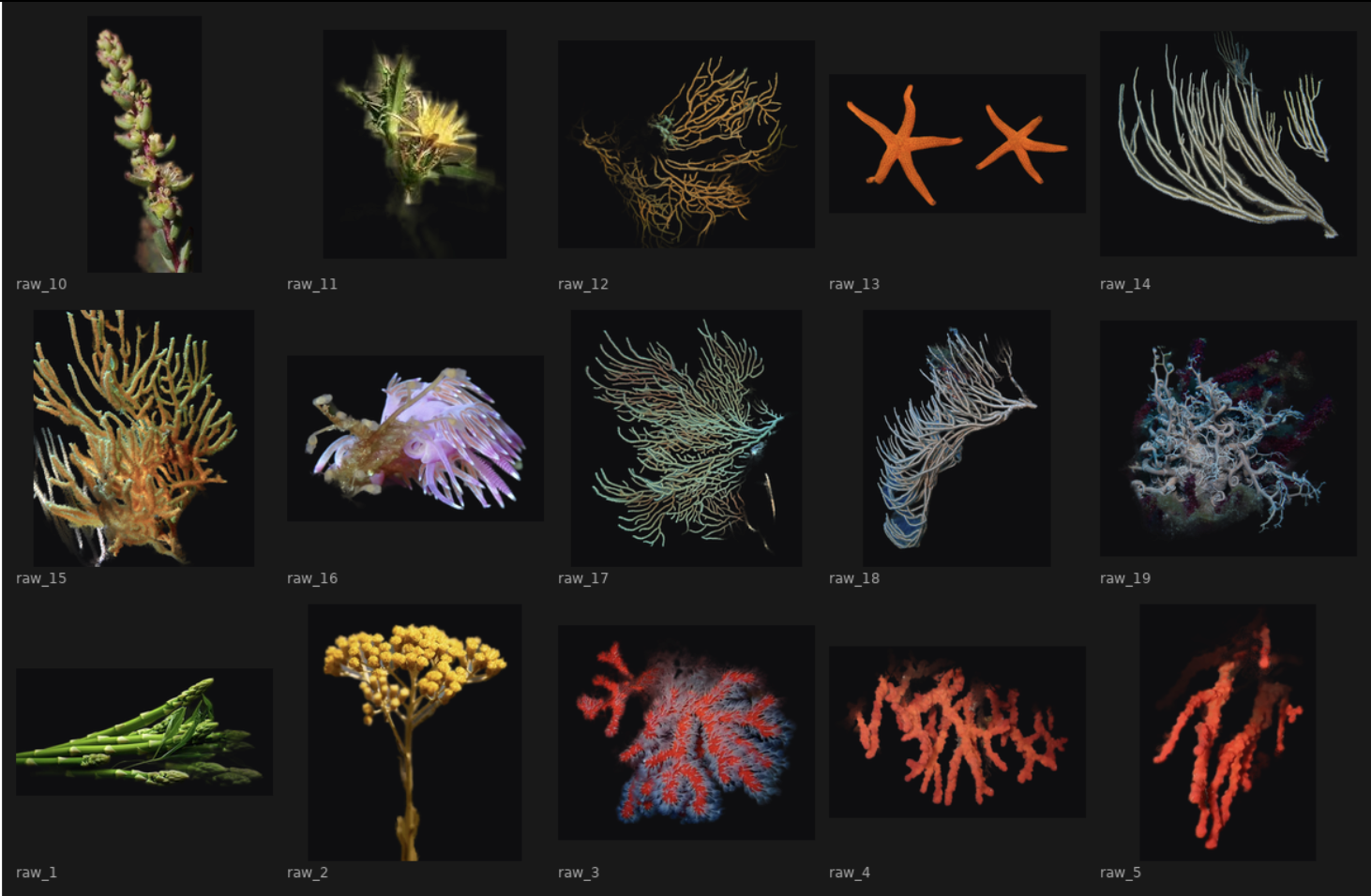
Urformen_ — research image.
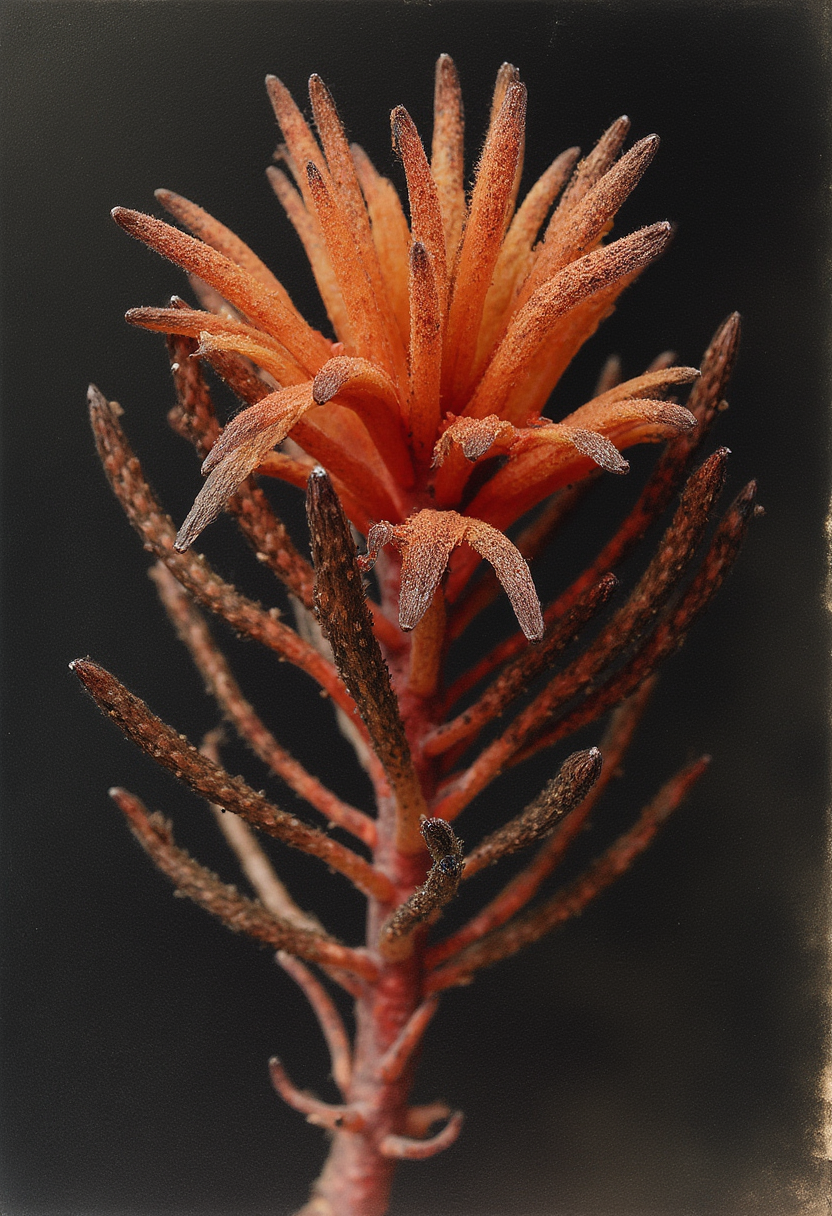
Urformen_ — research image.
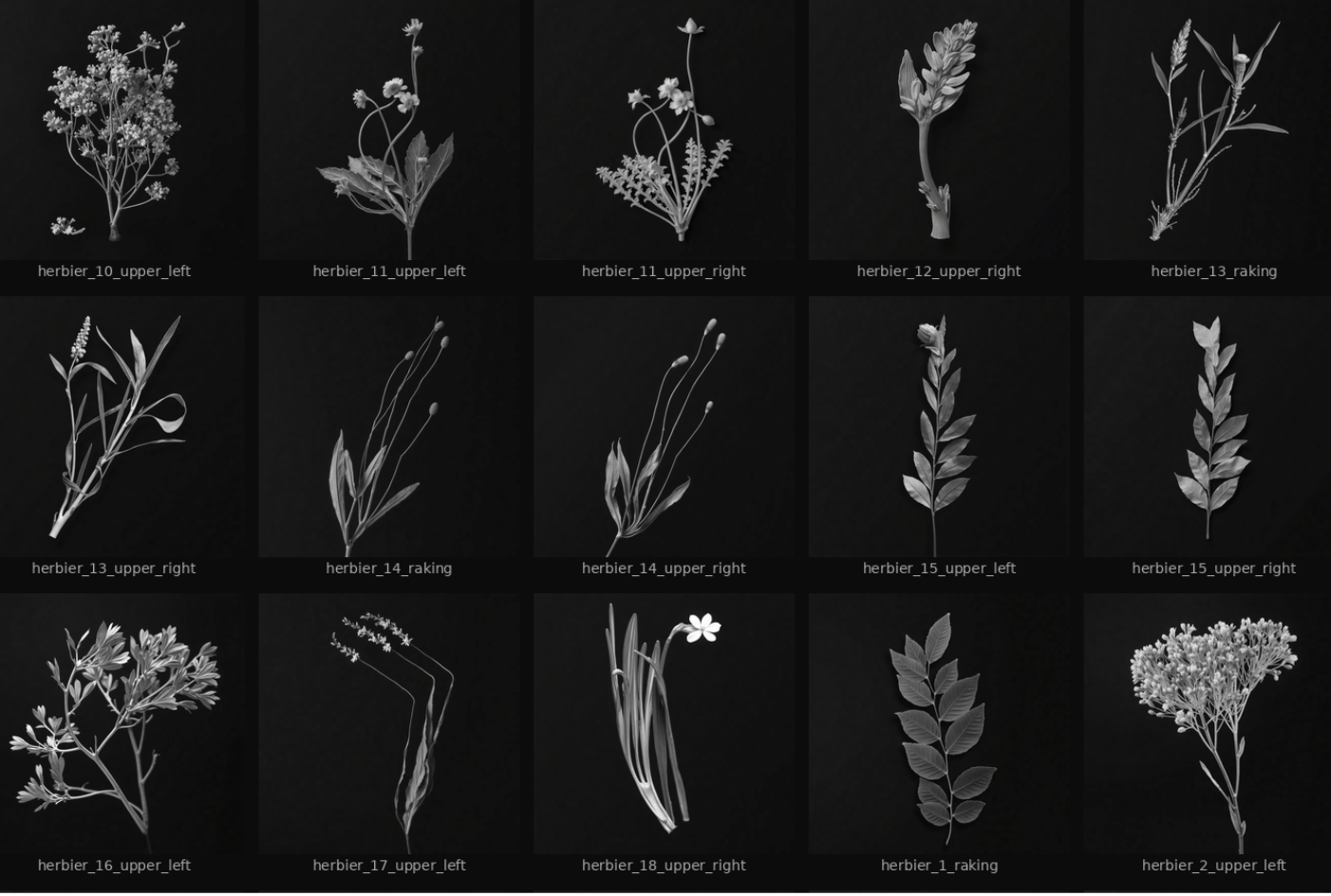
Urformen_ — research image.
SK_ Silent Key
Spirit machine for listening to residual frequencies • Sound and sculptural installation, suspended object
work in progress
In amateur radio, SK (…-.-; Silent Key) is the final prosign: it marks the end of a transmission and announces an operator’s death. The station falls silent; the signal disappears. SK is a machine designed to listen after that silence: a receiver for residual frequencies that persist in the airwaves.
The work begins with a childhood memory of my grandfather, a Morse code champion. After his death, the radio transmitted only white noise—the hiss between frequencies explored in research into Electronic Voice Phenomena (EVP).
The installation takes the form of a suspended organ: an iridescent silicone membrane threaded with copper networks that pick up the surrounding electromagnetic spectrum. A software-defined radio receiver and an algorithm scan this stream for vocal patterns and speech-like rhythms. Extending the lineage of the spirit machines of Tesla and Raudive, the work revisits them through cyberfeminist and ecofeminist perspectives. Noise—QRN, hiss and interference—becomes an active material carrying traces and potential voices. The sculpture has no loudspeaker: it speaks through its own body using a vibroacoustic transducer. The membrane oscillates, vibrates and murmurs, giving perceptible form to an archaeology of spectral memory.
Co-production: Ambivalences, an interregional programme for artistic creation in digital environments. Led by Electroni[k] in Brittany, Oblique/s and Station Mir in Normandy, and Stereolux in Pays de la Loire, with support from the French Ministry of Culture and the Regional Directorates of Cultural Affairs (DRAC) for Brittany, Normandy and Pays de la Loire.
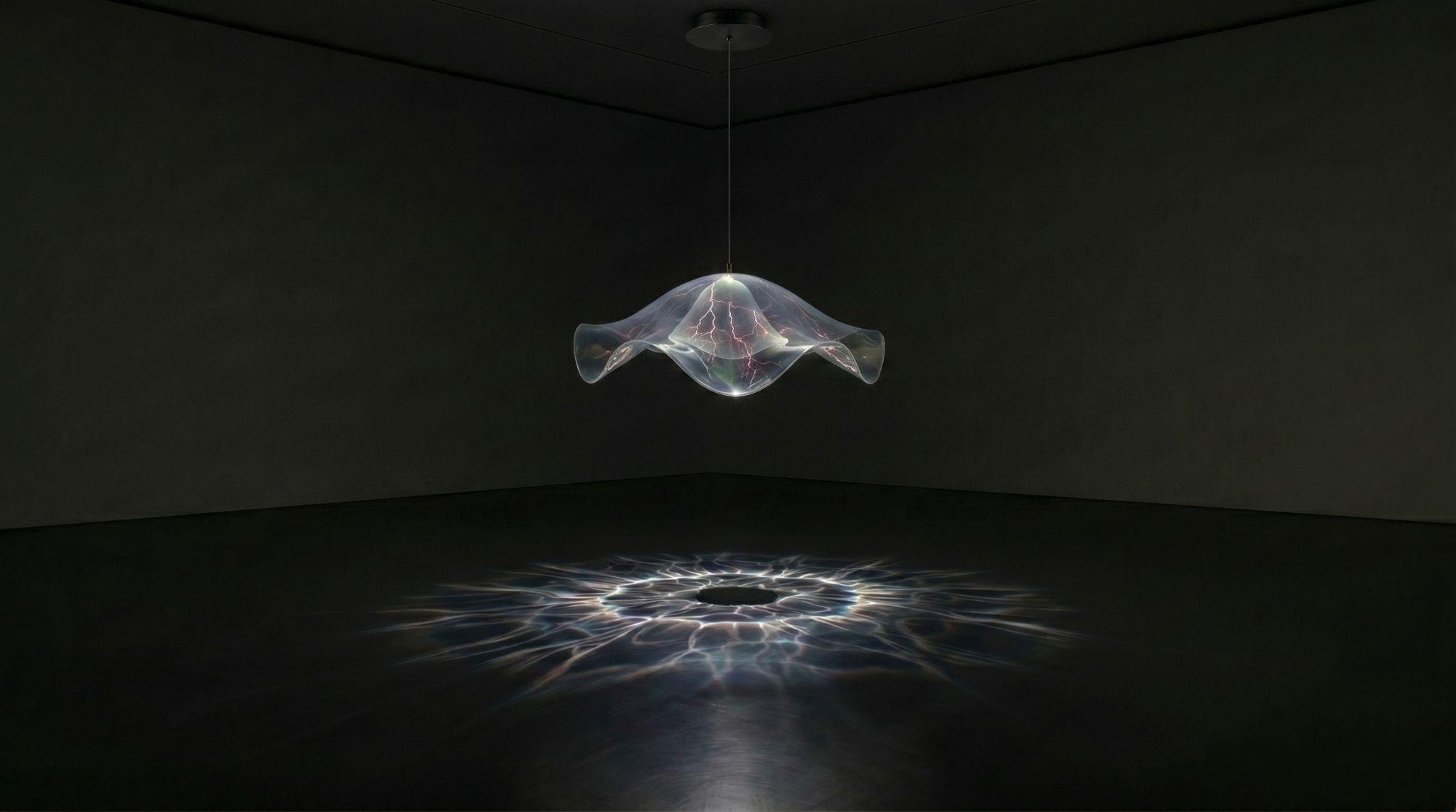
SK_ Silent Key — installation visualisation.
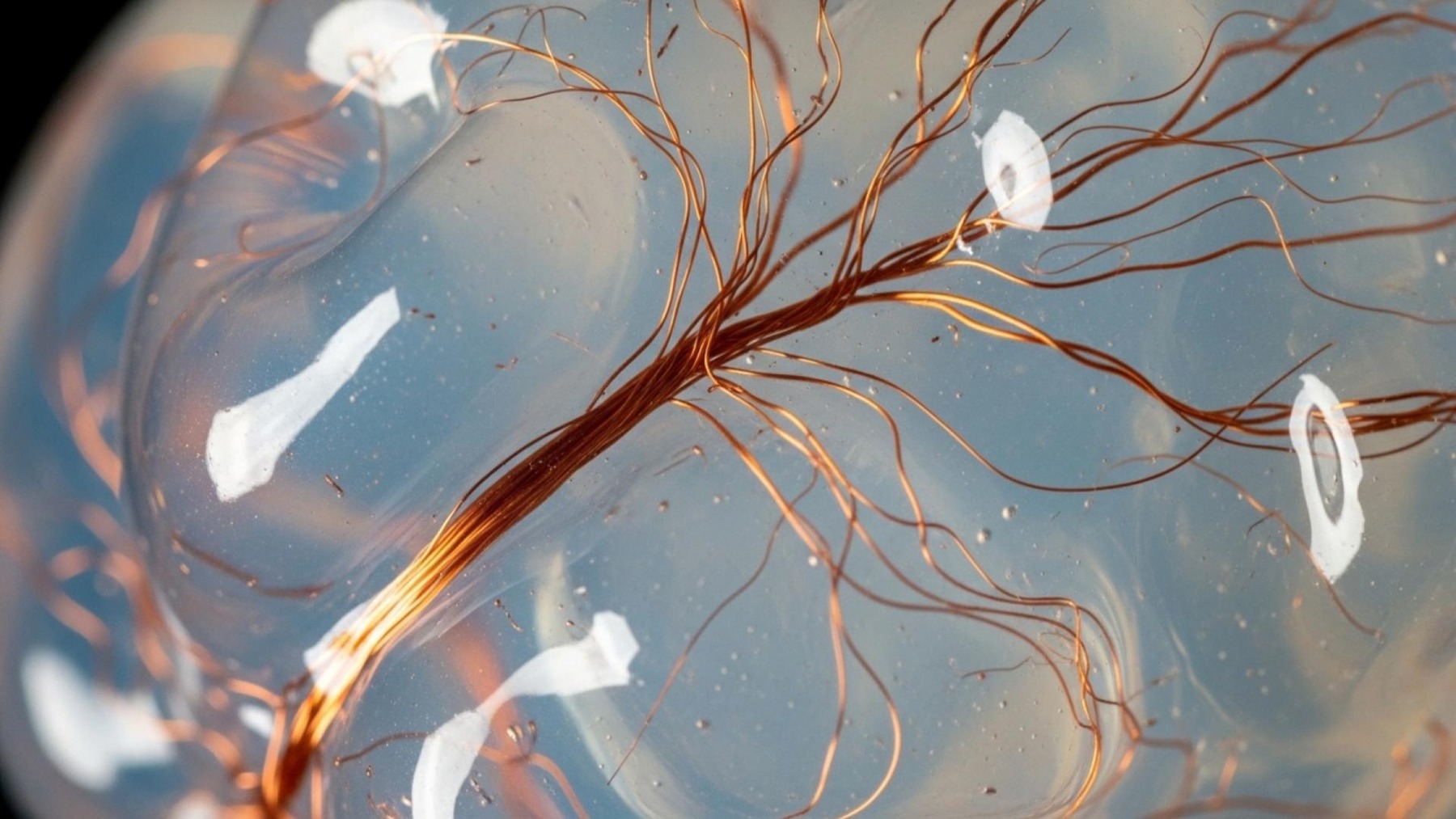
SK_ Silent Key — copper network study.
_birds
work in progress • 2026
I imagine a future in which machines search for signs of life in the residual noise of our civilisations. Working with a distant signal composed of shortwave transmissions picked up by remote receivers, an algorithm interprets what it receives and believes it recognises birdsong.
Each detection is recorded as a specimen: Latin name, confidence score, audio excerpt and photographic plate. Yet there are no birds in the signal. The machine applies a taxonomy learned from living organisms to electromagnetic material.
In ancient Rome, the augur marked out an area of the sky for observation—the templum—and interpreted the flight and song of birds passing through it. The interface takes up this principle in a contemporary form: concentric rings, inspired by Llull’s ars combinatoria and Bruno’s memory wheels, gradually associate a frequency with a species.
Each detection connects two systems that share no common language: the electromagnetic spectrum and ornithological taxonomy. The machine attempts to establish a correspondence and identify a trace of life within these residual frequencies.
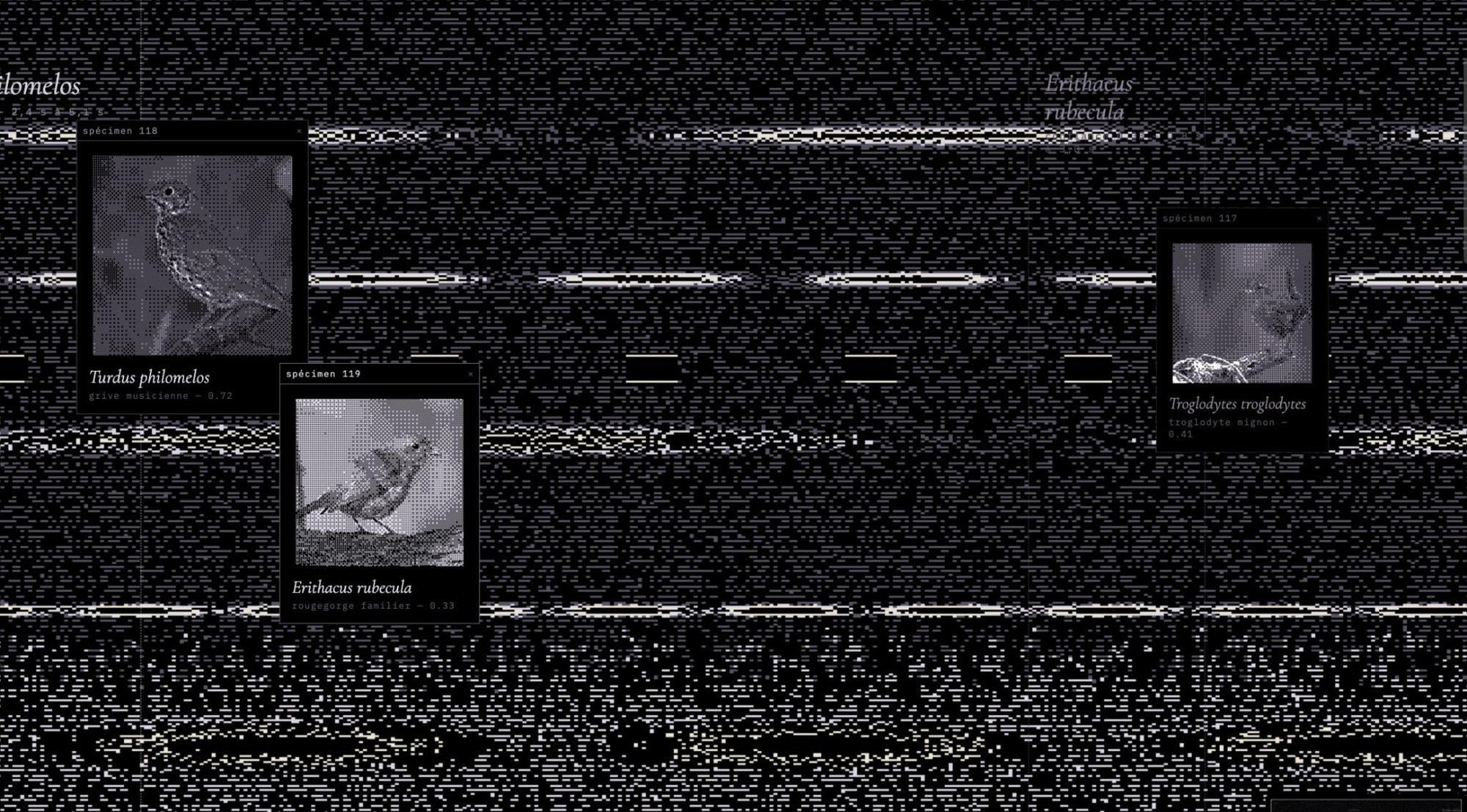
_birds — interface screenshot.
synthetic states.
work in progress • with artist and researcher Hugo Scurto • sculptural installation
Synthetic States is an interdisciplinary artistic research project exploring the potential of generative AI to produce non-ordinary states of consciousness. We propose an immersive installation in which AI would generate audiovisual sequences capable of inducing cognitive trance in a diverse range of participants. Drawing on cyberfeminism, the experience interweaves AI with the body-mind to help us recognise our inner resources and reconnect them with the world around us.

Eye-Roll Sign for Hypnotizability — Herbert Spiegel, 1972. Research reference.

Diagram of the hypnotic oracle.